

CO₂ transparency is increasingly becoming a clear requirement in procurement and a decisive criterion in supplier evaluation. Regulatory requirements and industry initiatives are significantly accelerating this development. What is needed are reliable data on Product Carbon Footprints (PCF) at product and material level – across the entire supply chain.
PCF transparency for every ZORGE rubber moulded part and composite component
With ZORGE, you now receive reliable CO₂ data for every individual product. This is made possible through the use of PACIFIC software from CircularTree – already proven at leading companies such as Forvia, Hella, Lear, Magna, Mercedes and Webasto.
This enables us to calculate the Product Carbon Footprint (PCF) of our products precisely and to provide it to you as a customer in a transparent and audit-ready format.
Understanding CO₂ emissions – and actively managing them
The PACIFIC solution is based on the standards of the Catena-X Product Carbon Footprint (PCF) rulebook and uses a data and calculation software to systematically capture, manage and analyse emissions along the value chain.
By linking our bills of materials with the internationally leading Ecoinvent database, precise and scientifically sound PCF’s are created. These include emission factors for materials, energy, transport, waste and production processes – making the climate impact of each product transparent and traceable.
Even without complete primary data from the supply chain, the system provides robust, methodologically sound estimates which are continuously refined as primary data becomes available. In this way, data quality improves step by step – and with it your level of transparency.
From data to real levers: identifying CO₂ hotspots
In addition to the calculation itself, PACIFIC makes it visible where emissions actually arise. The analysis clearly shows the largest CO₂ drivers within products and processes – so-called hotspots.
These insights create concrete starting points for reducing emissions and optimising materials choices, processes and supply chain structures.
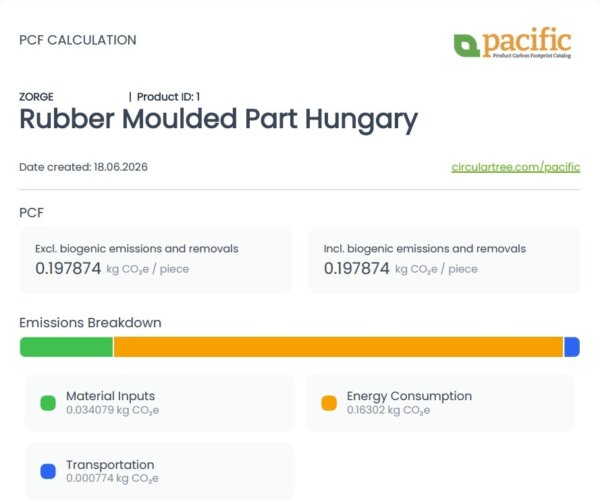
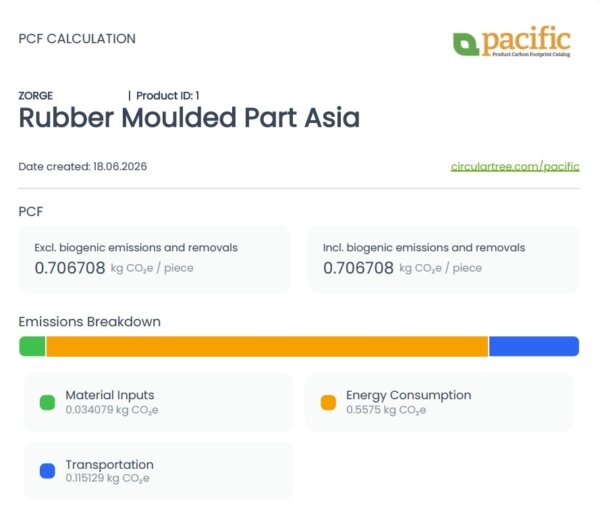
Illustrative impact of CO₂ emissions for a moulded rubber part produced in Hungary or Asia:
Material used: 0.1 kg of EPDM each
Energy consumption: 1 kWh each
Transport to Germany: lorry (Hungary), ship + lorry (Asia)
Your advantage: data-driven decisions with measurable impact
Together with our customers, we create the basis for well-founded decision-making, sustainable product development and continuous improvement of the CO₂ footprint along the entire value chain.
For further information and any questions regarding PCF values, our Quality & ESG Manager, Mr Bruno ZORGE,will be happy to assist you.
Glossary
Ecoinvent:
- the world’s leading environmental database for life cycle inventories (LCI data), regarded as the benchmark
- developed by leading Swiss research institutes more than 20 years ago
- managed independently by a non-profit organisation
- contains tens of thousands of data records on materials, products, transport, energy sources and waste
- forms the basis for life cycle assessments (LCA) and the calculation of greenhouse gas balances (Scope 1, 2, 3)
- provides the most comprehensive and transparent sources for calculating the carbon footprint of products
PACIFIC:
- a software platform from CircularTree, developed in collaboration with BA
- was developed in accordance with the standards set out in the Catena-X Product Carbon Footprint (PCF) Rulebook
- calculates PCFs and enables their secure, standardised exchange with customers and suppliers
Catena-X:
- the automotive industry’s first open, collaborative data ecosystem for optimised business processes through data-driven, digitalised value chains (from manufacturers through SME suppliers to recycling)
- compliant with European law on data sovereignty and data protection
- Catena-X will in future play a similar role in the standardised exchange of CO₂ data within the automotive industry to the one IMDS has played for years with regard to material data